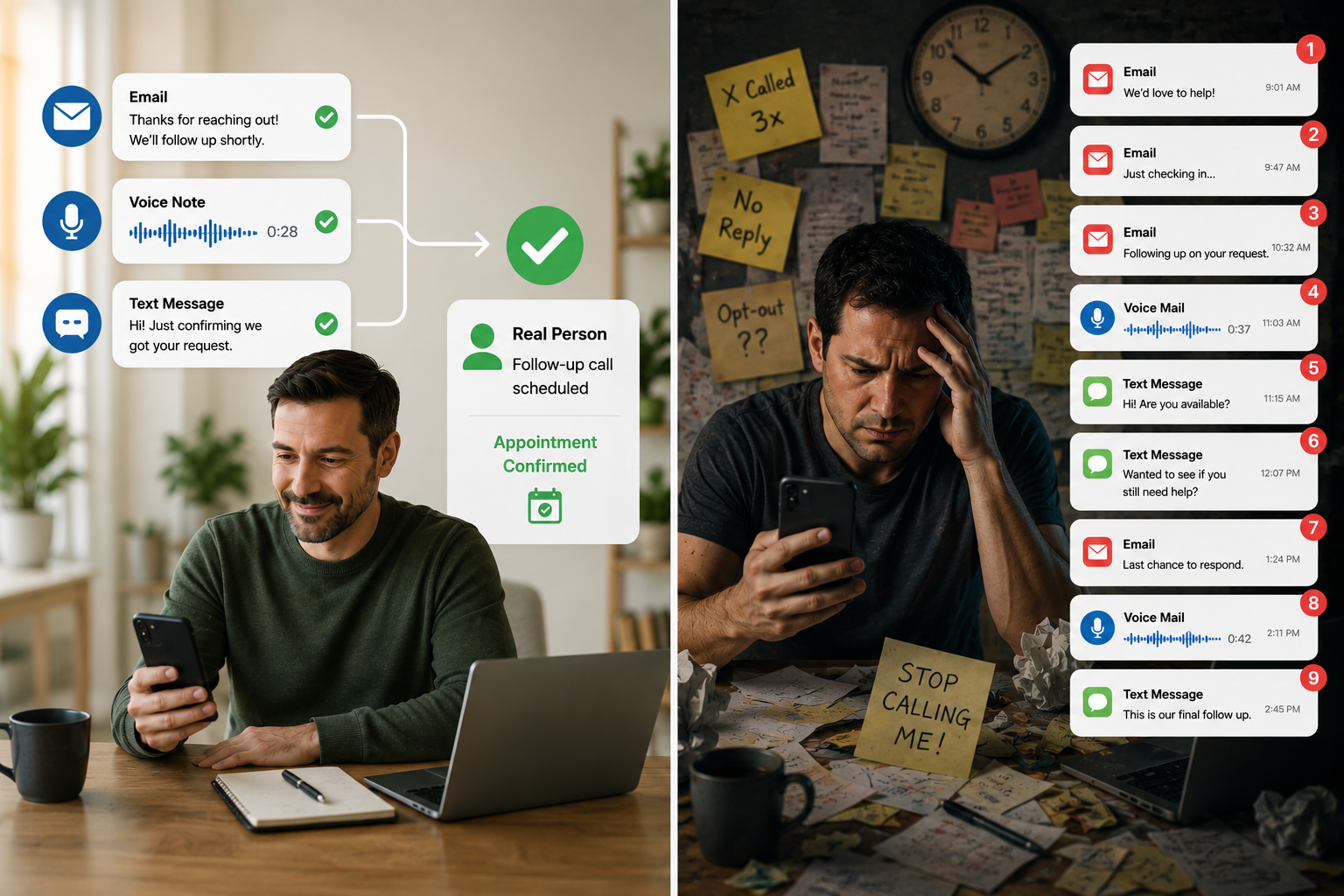
Unmanaged AI Is the Business Killer. Not AI.
Homeowners aren't rejecting automation. They're rejecting the version of it nobody bothered to manage. Here's the three-link accountability chain that separates automation that recovers revenue from automation that costs you customers.
Homeowners aren't rejecting automation. They're rejecting the version of it nobody bothered to manage.
I spent years managing bids in commercial roofing, then a decade running commercial property portfolios for a REIT. In both jobs, the difference between a good vendor and a bad one rarely came down to the crew they sent or the equipment on the truck. It came down to whether somebody actually walked the job after it was finished, checking the work instead of just signing off on it.
I got reminded of that reading through a comment thread recently. Homeowner after homeowner, describing the same experience. Call a company for a quote. Get called back multiple times, sometimes from numbers dressed up to look local. Get texted the same question the call just asked. Get emailed on top of it. One person said they'd rather hire a worse contractor than sit through that again. Another called four companies looking for an electrician and never got an answer at any of them, no callback, no follow-up, nothing. Called a fifth, got an answer immediately, and had that company at the house a day ahead of schedule.
Everybody Blamed The AI. Read Closer And The Diagnosis Changes.
Every comment in that thread pointed at the technology. Read closely, and every actual complaint traces back to what nobody checked before turning the system loose.
Automation should carry the repetitive weight so the human part of the job stays human. One line, buried in the comments, said it better than most marketing decks ever could.
Three channels firing without knowing what the other two already said. Opt-outs that don't actually stop anything. No path back to a real person when the system hits its limit. Every one of those points traces back to somebody skipping the part of the job that isn't glamorous: checking the thing after it's built.
This isn't only showing up in home services. Trend Research, the research arm of the cybersecurity firm Trend Micro, tested how nearly 100 AI models behave in customer-facing use and reached a similar conclusion from a completely different angle. Their top-line finding: putting AI output in front of customers without a verification step is what creates real exposure for a business. Their leading recommendation for fixing it was to require human review on any AI output a customer actually sees.
The AI Accountability Chain
Every automated system that earns trust instead of losing customers holds up the same three links. Break any one of them, and you get the stories from that thread. Hold all three, and automation becomes something a customer never even notices, the same way a well-run electrical system never gets noticed until it fails.
Sync
No channel should ever ask a customer something another channel already asked, or already got answered. A reply by text should tell the voice sequence to stand down. A reply by email should tell the text sequence to stand down. That has to be built as one connected system from day one, not three tools stitched together after the fact.
Most people's reference point for automated outreach is a blast tool, one message, sent to everyone, no coordination behind it. That's not what a properly built system looks like. Real infrastructure sits underneath it before a single message goes out: inboxes warmed over weeks so messages land in an inbox instead of spam, registration with carriers so texts actually deliver, voice configured to reach the contacts who never open an email or answer a text. Email carries the substance. Text creates visibility. Voice builds trust. Three channels, each doing a different job, not the same message fired three different ways. A person reviews that build before it launches and continually optimizes it after, which is the actual difference between a system and three tools stitched together.
The first business to respond wins the job 78% of the time, regardless of price.
Speed only works in your favor when it's coordinated. Uncoordinated speed is what got that lawn care company muted in the first place.
Stop
An opt-out has to actually opt someone out, on every channel, immediately. This is compliance work, and compliance work is boring, which is exactly why it gets skipped when a business is racing to launch.
For a home service company, that one gap causes more damage than a slow month ever could. A customer who unsubscribes and gets ignored anyway doesn't quietly go away. They tell their neighbors, and they leave a review, and that review sits on your Google Business Profile working against every dollar you spend on ads afterward.
Step-In
Automation exists to clear the repetitive work off a team's plate so a real conversation happens the moment it's actually needed, not to replace that moment. The electrician story from the top of this piece is the clearest version of it. Four companies, nobody ever answered. The fifth answered immediately, and that's who got the job a day early. Whether that's a person picking up the phone or a voice system built well enough that no call ever reaches voicemail, the outcome is the same: somebody has to actually be reachable.
A coordinator only works business hours. A well-run system runs at 6am on a Monday and 10pm on a Friday, and still knows exactly when to hand the conversation to a person instead of finishing it with a script.
What This Looks Like When It's Actually Managed
A gutter franchise in Jacksonville handed over a database of 5,673 contacts that had gone untouched since 2020.
First 603 contacts, worked correctly: 25 appointments booked and $128,000 in identified pipeline, in week one.
No new ads. No new spend. Just a system where every channel knew what the others had already said, every opt-out actually worked, and every reply that needed a person got one.
That's the difference between automation that costs you customers and automation that recovers revenue you already earned the right to.
See what this is worth against your numbers. Run the ROI Calculator →
The Companies Losing Customers Right Now Aren't Losing Them To AI
They're losing them to a system nobody kept watching after launch day. The fix is building automation with all three links intact, Sync, Stop, and Step-In, and keeping a person accountable for it long after the ribbon cutting is over.
Four companies missed that call. One didn't. Which one do you want to be?